
A bookmaker offers 1.95. An exchange shows 2.00 with a hypothetical 5% commission on positive market winnings. For one isolated back bet, the two quotes have the same payout: 1.95 effective decimal odds. The exchange's larger number disappears after the charge.
At a 2% commission rate, the same 2.00 quote becomes 1.98. Compare that final payout with the bookmaker's price. Comparing a commission percentage directly with a bookmaker's overround can give the wrong answer because the percentages apply to different amounts.
All prices and rates in the worked examples are hypothetical. They are not current offers, a universal exchange tariff or instructions to place bets.
Convert one back bet before comparing prices
Let O be the quoted decimal odds, c the commission fraction and s the stake. For an isolated back bet that wins, gross profit before commission is s(O-1). If commission is c times that positive profit, the returned amount including the stake is:
returned amount = s + s * (O - 1) * (1 - c)
effective odds = 1 + (O - 1) * (1 - c)
Commission is applied to profit here, so multiplying the entire decimal price by 1-c would charge the returned stake as well. At 2.00 and 5%, that shortcut gives 1.90 instead of 1.95.
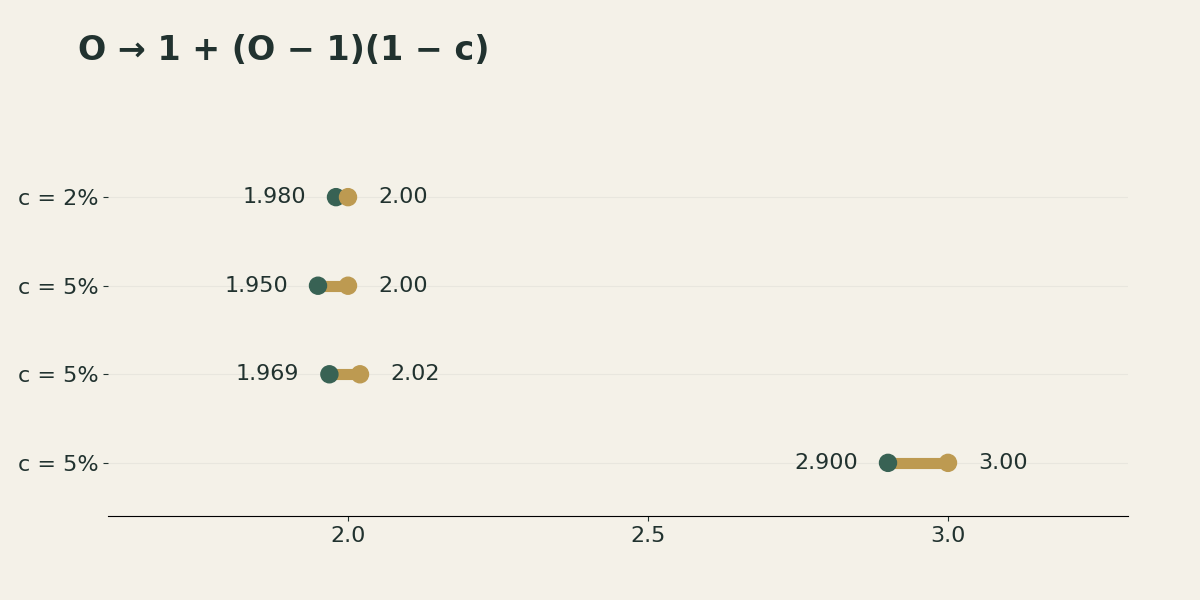
| Quoted exchange odds | Assumed commission | Effective odds | Net profit when a 100-unit stake wins | Break-even probability |
|---|---|---|---|---|
| 2.00 | 2% | 1.980 | 98.00 | 50.505% |
| 2.00 | 5% | 1.950 | 95.00 | 51.282% |
| 2.02 | 5% | 1.969 | 96.90 | 50.787% |
| 3.00 | 5% | 2.900 | 190.00 | 34.483% |
For this isolated-bet model, the break-even probability is 1 divided by effective odds. It is not an estimate of the event's actual probability. A price alone cannot establish that probability; see the limits of inferring fair odds from one quote.
The charge belongs to the market, not necessarily each winning bet
Betfair's commission documentation describes a charge on positive net winnings within a market. The applicable rate depends on the account's arrangements and location. Its general formula allows a market base rate and a discount. The example rates above are inputs, not a claim that every account pays either rate.
That distinction matters when several bets settle in the same market. Suppose, for one outcome, their pre-commission profits and losses are +100 and -80 units. Together they produce +20. At an assumed 5% rate, the charge is 1 unit and the final market profit is 19.
Charging 5 units on the +100 leg while ignoring the losing leg would produce 15 units after netting. That calculation applies the charge to the wrong base.
For each possible market outcome j, the cleaner calculation is:
net profit[j] = pre-commission market profit[j]
                - c * max(pre-commission market profit[j], 0)
This simplification assumes the stated commission is the only relevant charge. Check additional fees, settlement rules and any account-specific charges separately. Once several positions share a market, a single effective-odds number for one leg may no longer describe the entire exposure.
Why a “5% margin” comparison fails
Consider a complete hypothetical two-outcome bookmaker board priced at 1.90 and 1.90. The sum of reciprocal prices is:
S = 1/1.90 + 1/1.90 = 1.05263158
Its quoted overround is 5.2632%. If the underlying outcomes really are equally likely, a one-unit bet has expected gross return 0.5 * 1.90 = 0.95, or a 5% expected net loss.
Now assume the same fair 50/50 event is available on an exchange at 2.00 with 2% commission. Effective odds are 1.98, so expected gross return is 0.99 and expected net loss is 1%. The return comparison works because the example supplies the true probability explicitly. The overround calculation alone does not supply it.
This is also why quoted overround, modelled expected loss and realized operator hold need separate labels. A real bookmaker's overround does not reveal how much margin was loaded onto each outcome. For complete, matching boards, the no-vig calculator can compare model assumptions; it cannot turn one model into observed truth.
A higher quote may not be available for the whole stake
A displayed exchange price can have limited available volume. If part of a hypothetical order would match at 2.00 and part at 1.96, calculate the combined settlement from the amounts at those prices. Do not price the full stake at the best visible number.
Suppose an isolated 100-unit back order matches 30 units at 2.04 and 70 at 2.00. Its pre-commission winning profit is 30 * 1.04 + 70 * 1.00 = 101.20. At an assumed 5% rate, the net winning profit is 96.14. Add the returned 100-unit stake and divide by that stake: effective odds are 1.9614.
Pricing the entire order at 2.04 would instead give 1.988 after the same commission. The difference is 2.66 units of winning profit on this 100-unit example. The best displayed price was a poor description of the executable average.
For effective odds of 1.9614, a hypothetical probability estimate of 52% gives expected net return 0.52 * 1.9614 - 1 = 1.9928%. At 50%, the same arithmetic gives -1.93%. These probabilities are chosen assumptions, not predictions. If uncertainty in the probability estimate covers both values, the arithmetic does not support a confident claim of positive expected value. A precisely calculated fee cannot remove uncertainty from the event model.
Match the event and contract as carefully as the odds. Regulation-time and overtime-inclusive markets can settle differently. Player participation rules, dead heats, voids and deductions can also change the payout. A precise commission calculation on a different contract is still the wrong comparison.
Our recommendation is to keep two calculations separate: first the net payout for matching settlement outcomes, then an expected-value estimate using an explicitly sourced or modelled probability. If only the payout comparison is supported, stop there.
Find the quote that would match a bookmaker price
The same algebra can work backward. Let B be a bookmaker's decimal price and c the assumed exchange commission for one isolated back bet. Set the two effective prices equal:
B = 1 + (O - 1) * (1 - c)
matching exchange quote O = 1 + (B - 1) / (1 - c)
For B = 1.97 and c = 0.05, the matching quote is approximately 2.02105. An exchange quote of 2.02 gives only 1.969 after commission, slightly below 1.97. A quote of 2.03 gives 1.9785, slightly above it.
This is a payout threshold, not a value-betting threshold. The calculation does not know the true probability, the available volume or whether the two contracts settle identically. It also assumes the commission rate remains applicable to this isolated exposure.
If c is uncertain, calculate several rows rather than hiding a guessed rate. At zero commission the matching exchange price equals B, which is a useful arithmetic control. As c increases, the required quoted price increases too. A result moving the other way signals an error in the conversion.
A lay price needs a liability calculation
The earlier table concerns back bets. In an isolated lay position, the displayed lay stake is the amount won before commission if the named selection loses. The amount at risk is the liability:
liability = lay stake * (lay odds - 1)
At lay odds of 3.00 with a lay stake of 100 units, liability is 200. If the selection loses, a hypothetical 5% commission leaves 95 units of profit. If it wins, the position loses 200. Those outcomes are not equivalent to a 100-unit back bet at 3.00.
Expressed per unit of liability, the effective price on the complementary event is:
effective complementary odds = 1 + (1 - c) / (lay odds - 1)
The example gives 1.475. Its complementary event is “the named selection does not win.” In a three-outcome match-winner market that event can include both a draw and the other team's win. Compare it with a contract covering that same set of outcomes, rather than with an ordinary back quote on the opposing team alone.
As with several back positions, an existing position in the same market can change the net commission base. For a full account exposure, calculate every settlement outcome and its positive market profit before translating anything into an effective price.
A compact comparison record
For any saved comparison, record the event, market definition, selection, timestamp, quoted price, available volume and applicable commission. Keep the settlement assumptions beside the calculation. If the account rate is unknown, label it unknown and show a sensitivity range rather than assigning a standard fee.
The companion CSV reproduces the four price conversions above. It contains no live quotes. Recheck the account's current fee information before treating any conversion as applicable to a real market.
Additional worked examples (JSON). Commission documentation checked on 2 November 2026.